Williams Racing F1 · Piccadilly Lights · Creative Concepts · June 2026
Here To
Here To
Race.
Five interactive concepts for London's most famous screen
Five interactive concepts for London's most famous screen
Williams Racing are one of the most recognised names in Formula 1 — seven Constructors' Championships, a name everyone knows. That's the problem. Awareness isn't the gap. The gap is faith.
People love Williams the way you love an underdog: with warmth, without expectation. We have a single 10-minute slot on Piccadilly Lights — London's largest screen — to change that. Not to remind people who Williams are. To make them feel what Williams are.
The screen features DeepScreen technology: audience sensing, live data integration, reactive formats. The format is anamorphic — objects can appear to break the flat plane and exist in real space. The fan zone beneath the screen is part of the canvas.
01 · Concept
You're not watching the driver.
The driver is watching you.
Insight
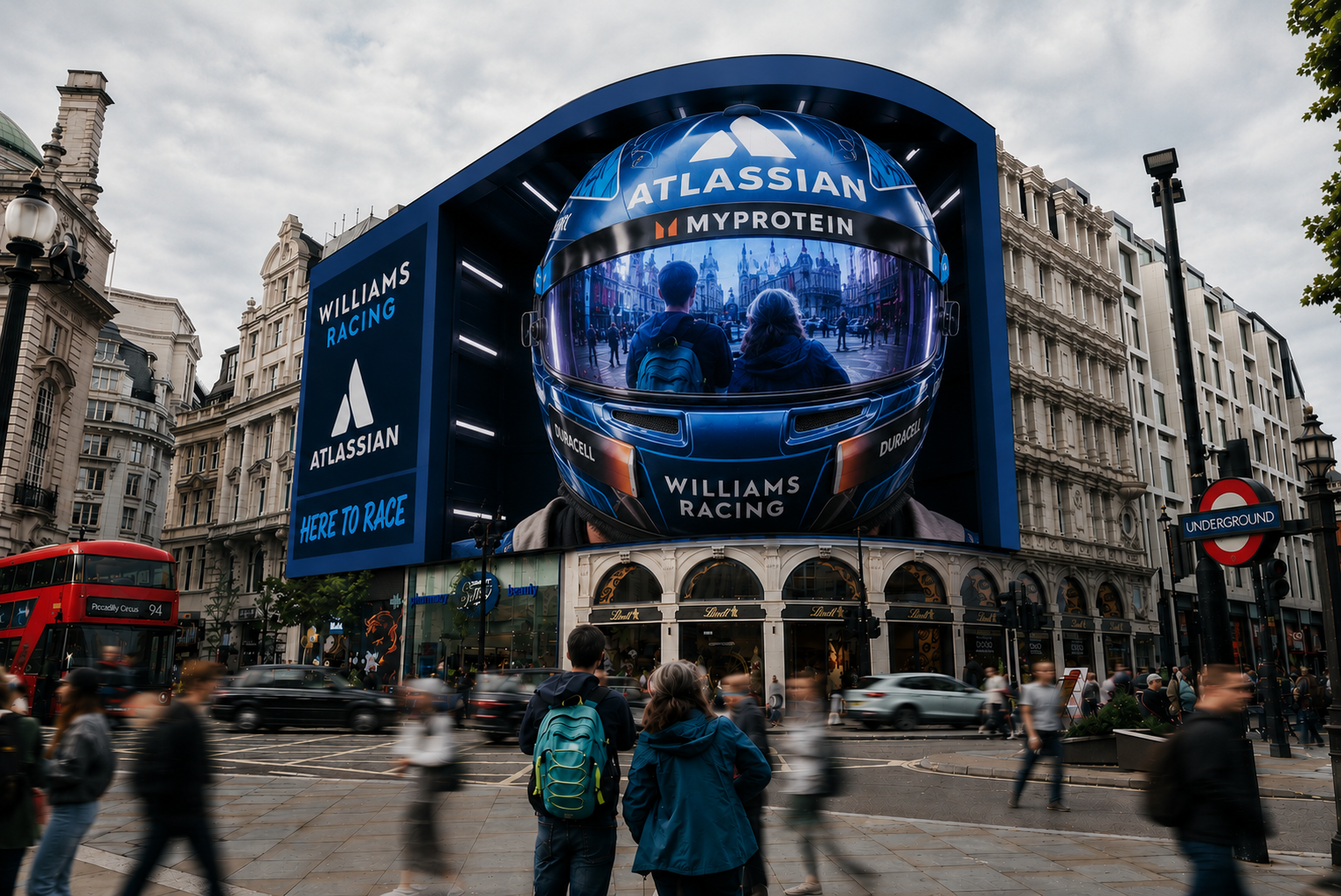
Williams has a warmth problem, not an awareness problem. The relationship is one-directional — fans watch the team, but the team never looks back. The driver's visor is one of the most iconic images in Formula 1: a closed, reflective surface that shows the world but reveals nothing inside. Flip that. Make the visor show the crowd back to themselves.
Concept
The anamorphic screen renders a giant Williams F1 helmet, visor down. Using a live camera feed composited into the reflective visor surface in real time, the crowd sees themselves — their actual faces, moving and reacting — reflected inside the driver's helmet. You're not a spectator. You're what the driver sees before the race starts.
Why it works
The filmable moment
Your face, at scale, inside a Formula 1 helmet on the biggest screen in London.
02 · Concept
You always lose.
By how much is the point.
Insight
F1 speed is intellectually understood but never physically felt. The margins — tenths of seconds, fractions of reaction time — are abstract numbers that don't connect. But the moment your body starts competing, it understands the gap. Williams' identity is about showing up to race. This mechanic makes everyone a racer, and makes the precision real rather than statistical.
Concept
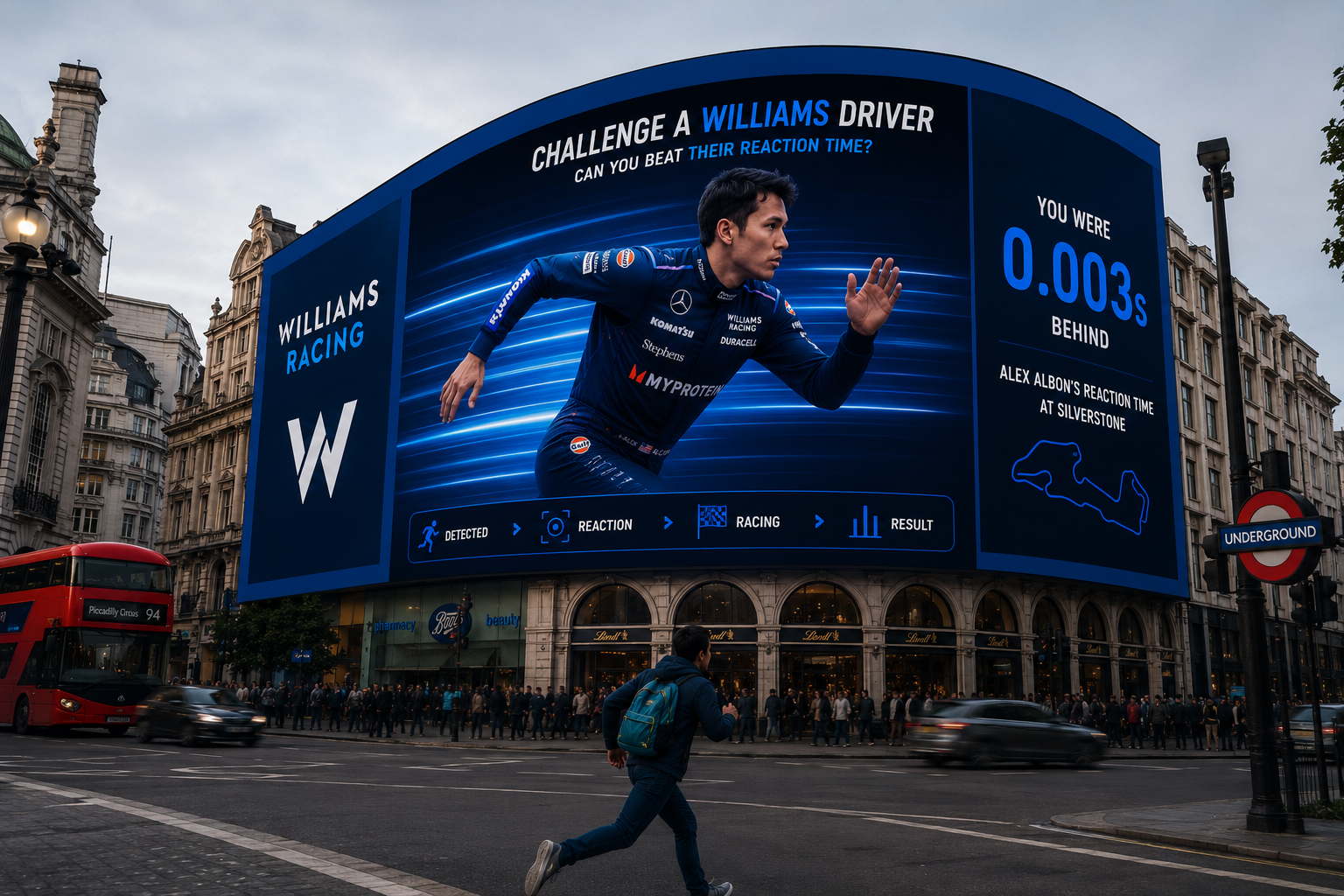
Audience sensing detects a person in motion. The screen locks on to them immediately. A Williams driver appears in the cockpit and a real-time race begins — their pace versus the car. They always lose. But by exactly how much is displayed as a personal stat: "You were 0.003 seconds behind Alex Albon's reaction time at Silverstone."
Why it works
The filmable moment
The screen is racing you — specifically — and showing exactly how close you came to a Formula 1 driver.
03 · Concept
The race starts
before the car moves.
Insight
Every Formula 1 fan knows the moment. Five red lights. Silence. A fraction of a second that separates world-class drivers from everyone else. Reaction time isn't just part of Formula 1 — it's where every race begins. That moment is universally understood, instantly felt, and requires no explanation. It belongs to everyone who has ever watched a start.
Concept
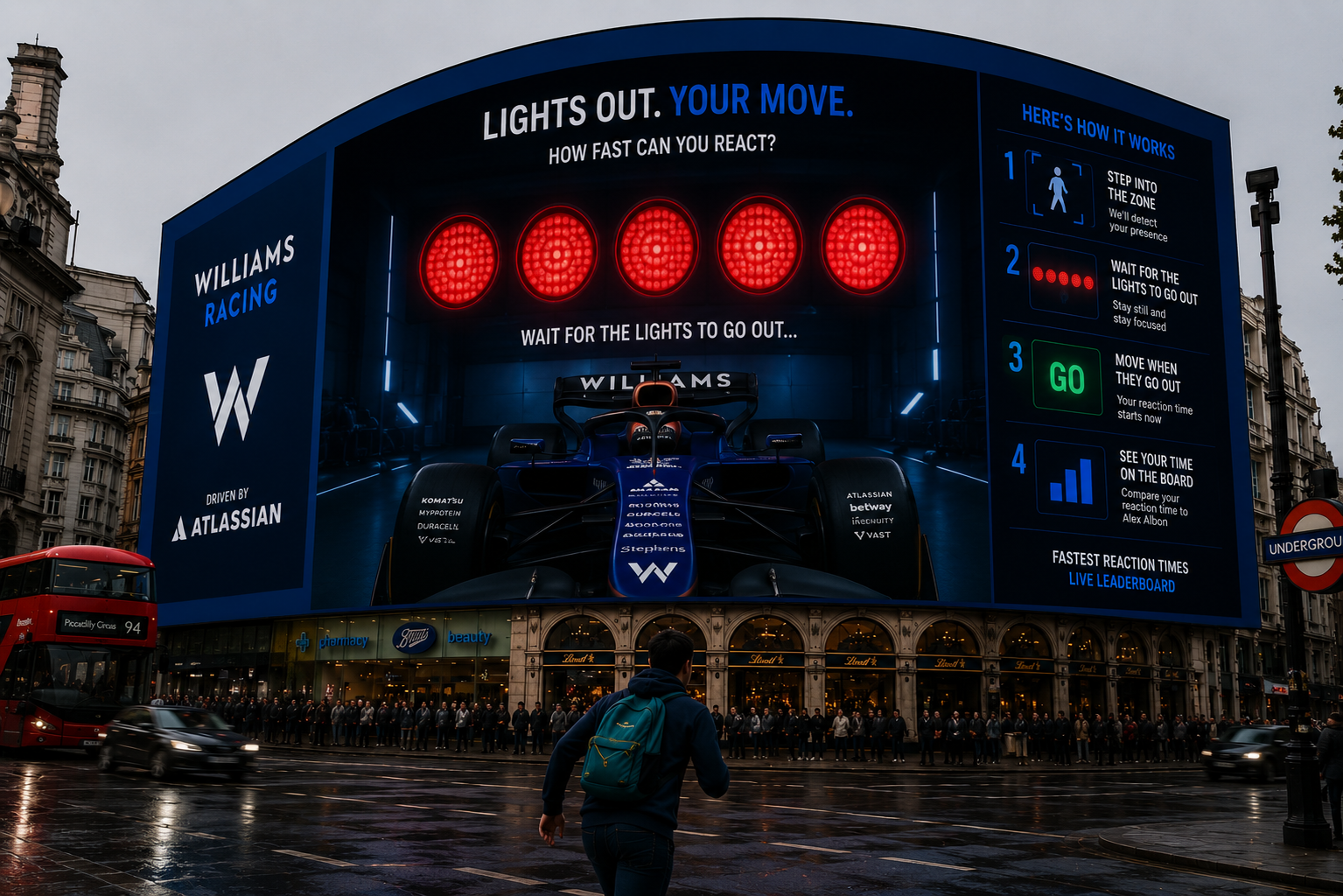
For one moment, the street becomes the starting grid. A giant Williams Racing installation challenges pedestrians to react to the iconic F1 starting lights. When the lights go out, they must make their first move as quickly as possible. Their reaction time is instantly compared against real Williams Racing data. The closer you are, the closer you are to thinking like a Formula 1 driver.
Why it works
The filmable moment
Five red lights on the biggest screen in London go out — and the street holds its breath.
04 · Concept
Grove just opened
in Piccadilly Circus.
Insight
Williams is one of Britain's greatest racing institutions — seven Constructors' Championships built from a village in Oxfordshire. Yet most Londoners walk past the brand every day without thinking about it. Their garage is the one place where everything they are comes together. This concept brings that world to the city that hosts their home race. Not as advertising. As presence.
Concept
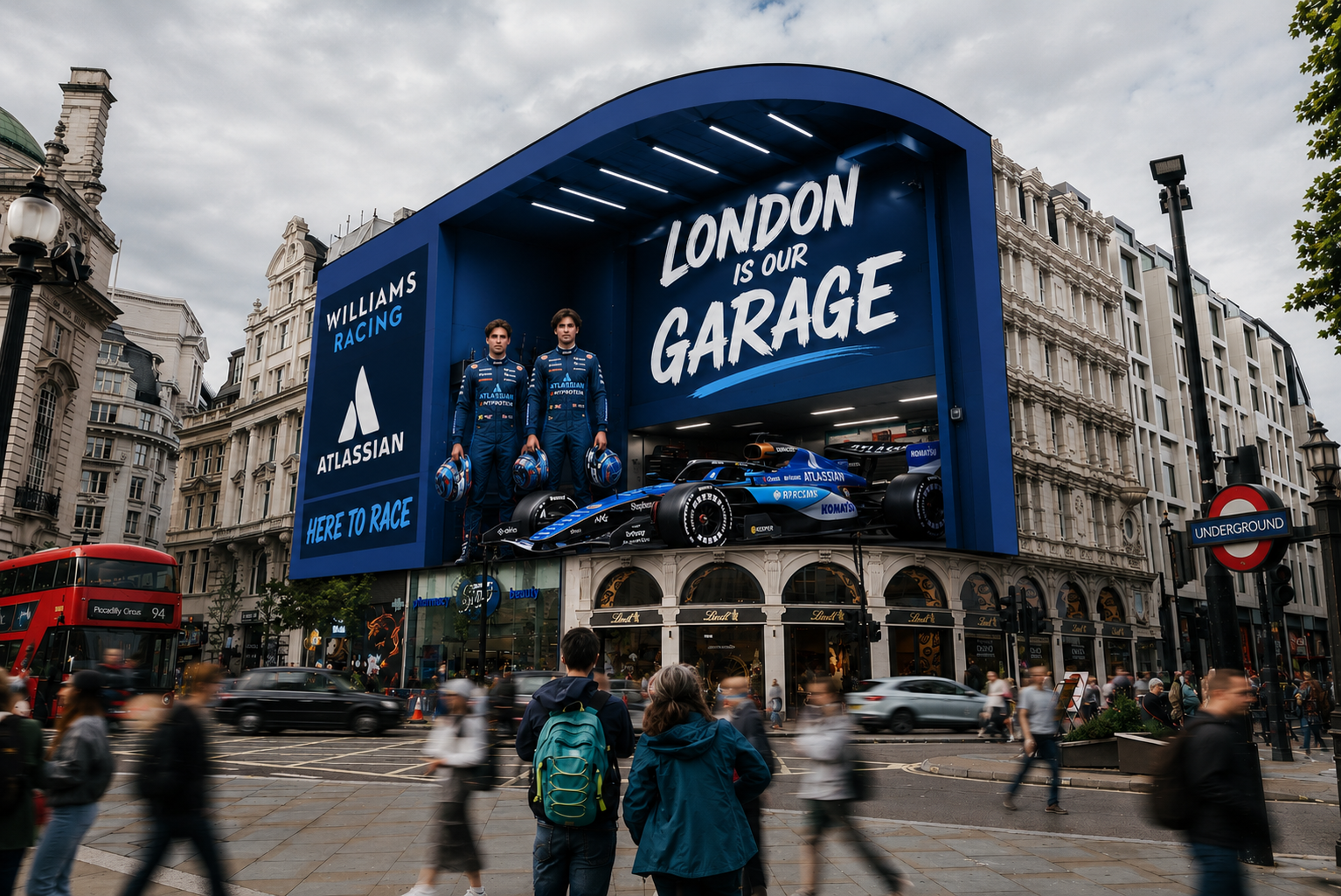
The entire screen opens like a garage door — the anamorphic format used at its most powerful. Behind it: the real Williams garage. Mechanics. Drivers. Engineers. The car. Everything at 1:1 scale. It feels like Grove has appeared in the middle of London. Over 10 minutes the garage comes alive — and then the car leaves. This is the hero of the slot.
Why it works
The filmable moment
A garage door opening onto Piccadilly Circus — and a Williams F1 car driving out onto Regent Street.
05 · Concept
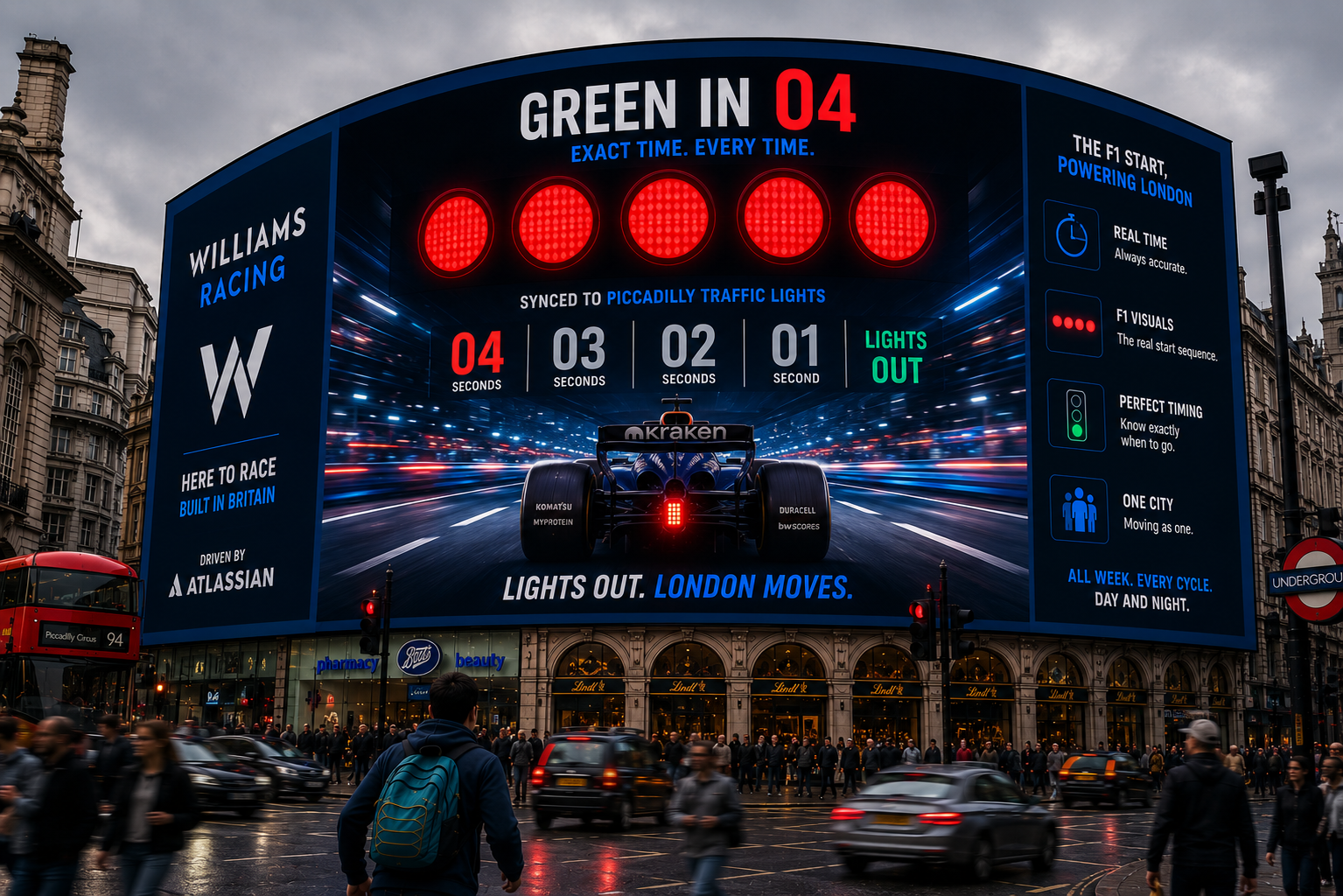
The only countdown
that stops traffic.
Insight
Every driver stopped at a red light knows the feeling — the wait, the anticipation, the exact moment it changes. It's the closest most people will ever get to a Formula 1 start. For the week of the British Grand Prix, Williams owns that moment on Regent Street. Not as a screen. As infrastructure.
Concept
The billboard syncs in real time to Piccadilly Circus's traffic signals. When the lights turn red, the screen activates — counting down the seconds to green using the language and visual grammar of an F1 starting procedure. The red phase builds tension. The amber is the warning. When the light goes green: Lights Out. This runs all week, every cycle, to every driver and pedestrian on Regent Street.
Why it works
The filmable moment
A Williams Racing countdown appears on Piccadilly Circus the moment your light turns red. Then the lights go out.
All five executions are built on technology and creative mechanics that are not location-dependent. Each concept can be adapted for equivalent large-format screens in any major market — same idea, same impact, different city.